
Mahashivratri is one of the most sacred Hindu festivals, widely known as the divine union of Lord Shiva and Maa Parvati. While many celebrate this night through fasting, prayers, and offerings, Mahashivratri is far more than the celebration of a marriage. It symbolizes a cosmic union—the merging of Shiva, the supreme consciousness, and Shakti, the dynamic energy of creation.
This night opens a rare spiritual window—an opportunity to rise beyond the ordinary mind and connect with one’s higher consciousness. It is believed that the cosmic energies on this night are at their peak, making it easier to channelize inner energy, experience deep stillness, and touch a state of inner enlightenment.
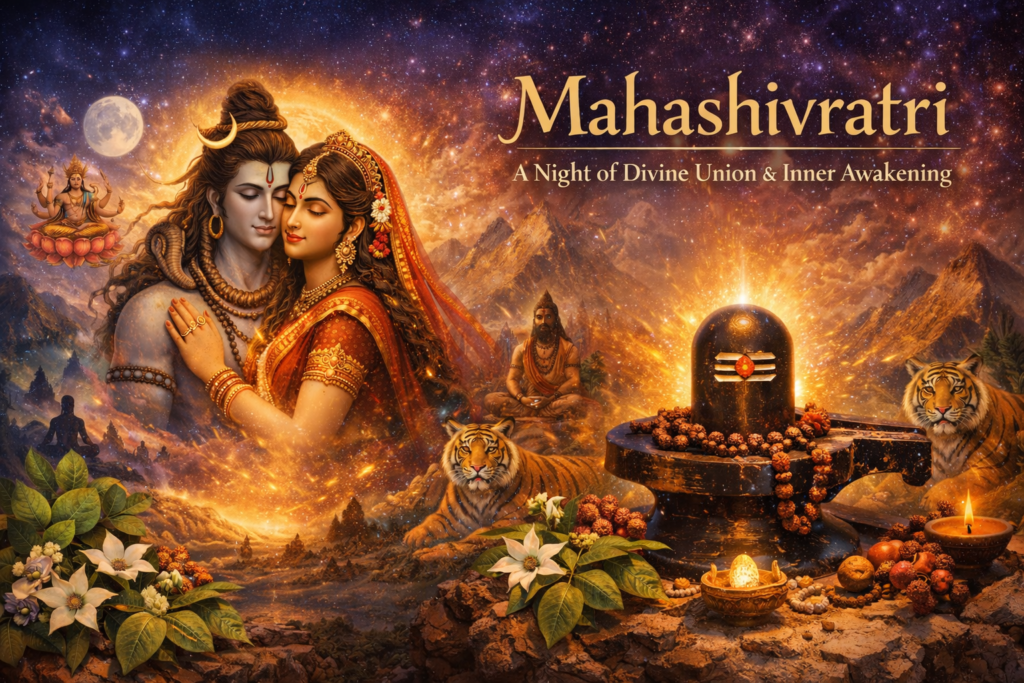
The Symbolism of Rituals
Every ritual performed on Mahashivratri carries profound meaning.
- Bel Patra (Bilva leaves) represent the trinity—Brahma, Vishnu, and Mahesh, symbolizing the three gunas (sattva, rajas, tamas) and the three dimensions of time—past, present, and future. The cooling nature of the Bilva also reflects seasonal transitions and balance within nature.
- Dhatura symbolizes toxicity, ego, and darkness. Shiva’s acceptance of Dhatura reflects his mastery over poison, death, and fear—earning him the name Mahakaal, the one beyond time and mortality.
- Ber and other forest-grown offerings signify Shiva’s simplicity and his deep connection with tribal life and nature. Shiva is the supreme yogi—untouched by luxury, deeply rooted in the natural world, and accepting of all without discrimination.
The Divine Feminine: Maa Parvati
Maa Parvati represents the pure feminine essence. She embodies love, grace, devotion, and emotional depth. On Mahashivratri, she reflects every woman who embraces her femininity—who adorns herself, expresses emotion, feels shy yet courageous in love, and accepts her partner wholly.
She loves Shiva not despite his ascetic nature, but because of who he truly is. She embraces everything her beloved embraces. Through her, we understand that true love is acceptance without conditions.
Shiva–Shakti: The Ultimate Balance
Together, Shiva and Shakti represent two incomplete forces that find fulfillment in unity. Shiva is boundless consciousness—beyond life and death, form and time. Yet without Shakti, consciousness remains unexpressed. Shakti is movement, creation, and manifestation—but without Shiva, energy lacks direction.
Their union transcends ego and desire, forming the purest state of love—Shiva–Shakti, the source of all creation.
The Deeper Meaning of the Shivalinga
The Shivalinga symbolizes creation at a cosmic level. It does not represent sexuality; rather, it signifies the union of consciousness and energy that gives rise to existence. In Hindu philosophy, creation whether cosmic or human, is a sacred act, which is why in our culture intimacy is considered a powerful exchange of energy, not merely a physical act .
A Night of Alignment and Balance
Mahashivratri reminds us that Shakti bows to Shiva, not out of submission, but reverence—and Shiva, in turn, stands free of ego, knowing that without Shakti, he is incomplete. Together they form Ardhanarishvara, the perfect balance of masculine and feminine energies.
This is the only night believed to unite all cosmic forces—living and non-living, creation and destruction, nature and the beyond—celebrating balance, alignment, and the eternal creator.
Celebrate Mahashivratri Differently
On this Mahashivratri, go beyond rituals. Sit in stillness. Meditate with intention. Awaken and align your Ida, Pingala, and Sushumna nadis. Listen to your body. Pause. Reconnect with nature, animals, and children—because Shiva exists in innocence, simplicity, and awareness. Understand the power of your energy, feel it and enhance it.
Remember, Shiva is not just a god—Shiva is a state of being within you. When you connect with Shiva, Shakti blesses you with strength, wisdom, compassion, love, and softness.
Make this Mahashivratri meaningful.
Make it powerful.
Make it a night of inner awakening.
Love
shweta